
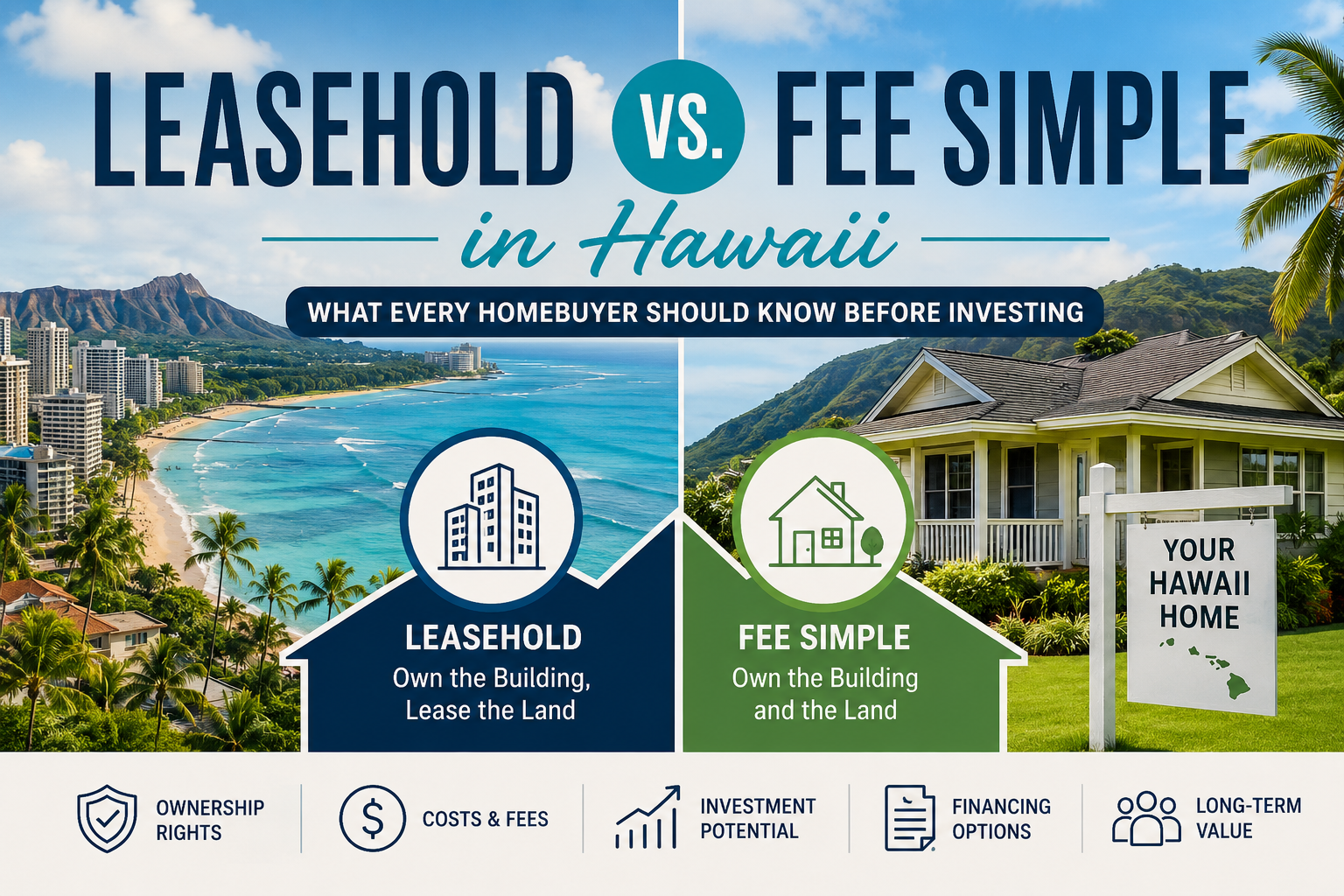
Hawaii’s real estate market is unlike any other in the United States. Limited land, high demand, and a complex mix of ownership structures make buying property here a more involved process than in most states. Before you fall in love with an oceanfront condo in Waikiki or a home on Maui, there’s one fundamental question you need to answer: what type of ownership are you actually buying?
Two structures define Hawaii’s property market—leasehold and fee simple. The ownership type you choose affects everything from how you finance the purchase to how much the property appreciates over time, and even what happens when you pass it on to your family. Understanding leasehold vs. fee simple in Hawaii isn’t just helpful—it’s essential.
Understanding Property Ownership in Hawaii
What Is Fee Simple Ownership?
Fee simple is the most complete form of property ownership available. When you purchase a fee simple property, you own both the land and the structure on it. That means full rights to sell, remodel, rent out, or pass the property to your heirs—without restriction from a landowner.
Because fee simple conveys maximum control, it’s the most common ownership type in the U.S. and the most straightforward for buyers to understand. In Hawaii, fee simple properties tend to command higher prices, but they also offer the most security and flexibility.
What Is Leasehold Ownership?
Leasehold ownership is different. You purchase the structure—the home, condo, or building—but the land beneath it belongs to someone else. In exchange for using that land, you pay ground rent, either monthly or on another periodic schedule.
Every leasehold property comes with a lease expiration date. Once that date passes, ownership of the structure can revert to the landowner unless the lease is renewed or the land is purchased. In Hawaii, some leasehold properties are tied to large private estates or trusts that have historically retained vast amounts of land across the islands.
Leasehold vs. Fee Simple in Hawaii: Key Differences
| Feature | Fee Simple | Leasehold |
| Land Ownership | ✓ | ✗ |
| Monthly Ground Rent | No | Yes |
| Financing Options | Easier | More Limited |
| Property Value | Generally Higher | Often Lower |
| Long-Term Security | High | Depends on Lease |
| Resale Potential | Strong | Can Be Challenging |
| Estate Planning | Easier | Lease Restrictions Apply |
Advantages of Fee Simple Ownership
Full Ownership Rights
With fee simple ownership, you have complete control over your property. There’s no landowner to answer to, no ground rent to budget for, and no lease clock ticking down. What you buy is truly yours.
Better Investment Potential
Fee simple properties in Hawaii have historically appreciated at a strong rate. Because buyers generally prefer full ownership, demand stays high—and higher demand supports stronger long-term value.
Easier Mortgage Financing
Most lenders are far more comfortable financing fee simple properties. You’ll typically have access to a wider pool of loan products, more competitive interest rates, and better terms overall.
Greater Flexibility
Want to renovate? Rent it out? Leave it to your children? Fee simple ownership allows all of this with far fewer complications. There are no lease clauses limiting what you can do with the property.
Advantages of Leasehold Ownership
Lower Purchase Price
Leasehold properties are typically priced significantly below comparable fee simple options. For buyers with a limited budget, this lower entry point can make otherwise unattainable locations accessible.
Access to Prime Hawaii Locations
Some of the most desirable spots in Hawaii—beachfront Waikiki condos, resort communities, luxury neighborhoods on Oahu and Maui—include leasehold options. For buyers who want a specific location at a reduced cost, leasehold can open doors that fee simple cannot.
Good Short-Term Ownership Option
If you’re purchasing a vacation home, planning a temporary relocation, or simply looking for a lifestyle purchase without a long-term commitment, leasehold may be a practical fit—especially if the lease still has many years remaining.
Potential Drawbacks of Fee Simple Ownership
Fee simple ownership is the preferred option for most buyers, but it comes with trade-offs. Purchase prices are considerably higher, and down payments reflect that. Larger upfront capital is required, which can be a barrier for first-time buyers or those relocating from markets with lower property values. Property taxes also tend to be higher on fee simple properties, adding to the long-term cost of ownership.
Potential Risks of Leasehold Ownership
Lease Expiration
When a leasehold lease expires, ownership of the structure may revert to the landowner. Lease renewal is never guaranteed, and uncertainty around expiration dates can create significant financial risk—particularly if you’re nearing the end of a lease term.
Ground Rent Increases
Most leasehold agreements include scheduled rent renegotiations. At these intervals, ground rent can increase substantially—sometimes by amounts that dramatically change the cost of ownership. Buyers should always review when renegotiations are scheduled and what the terms allow.
Financing Challenges
Many lenders won’t finance a leasehold property, and those that do often impose stricter requirements: higher interest rates, shorter loan terms, or a requirement that the lease extends a minimum number of years beyond the mortgage term. This can complicate both purchase and resale.
Resale Difficulties
As a leasehold property’s expiration date draws closer, buyer interest tends to decline. Reduced market demand translates to reduced resale value. Selling a leasehold property with fewer than 30 years remaining on the lease can be particularly challenging.
Which Ownership Type Is Right for You?
Fee simple may be the better choice if you:
- Want long-term ownership with strong appreciation potential
- Plan to build equity and pass the property to family
- Need conventional mortgage financing
- View the purchase primarily as an investment
Leasehold may make sense if you:
- Have a limited budget and want access to a premium location
- Are buying a vacation condo or planning a short-term stay
- Fully understand the lease terms and remaining duration
- Are comfortable with ongoing ground rent payments
The right answer depends entirely on your financial goals, timeline, and how you intend to use the property.
Questions Every Buyer Should Ask Before Purchasing a Leasehold Property
Before signing anything on a leasehold property, get clear answers to the following:
- When does the lease expire?
- Is the lease renewable, and under what conditions?
- What are the current ground rent payments?
- When is the next rent renegotiation, and what are the terms?
- Is there an option to purchase the land outright?
- Will lenders finance this specific property?
- Are there restrictions on renting or remodeling?
- How has the property’s value changed as the lease has shortened?
These questions aren’t just due diligence—they’re the difference between a sound investment and a costly mistake.
Tips for Buying Property in Hawaii
- Work with a local expert. Hawaii’s real estate market has its own rules, customs, and legal nuances. A locally experienced agent is invaluable.
- Review all lease documents carefully. Don’t rely on summaries. Read the full lease, and have an attorney review it if needed.
- Understand financing requirements upfront. Confirm that lenders will finance the property before you get too far into the process.
- Factor in total ownership costs. Purchase price is only part of the picture. Ground rent, property taxes, HOA fees, and potential rent increases all affect your long-term financial picture.
- Compare multiple properties. Evaluate both leasehold and fee simple options side by side before committing.
Why Professional Guidance Matters
Hawaii has some of the most distinctive real estate laws in the country. Land ownership history, indigenous land rights, and large private estate holdings have all shaped the market in ways that don’t exist elsewhere. Buyers who come in without local knowledge often encounter expensive surprises.
An experienced Hawaii real estate professional can explain how ownership structures affect your specific situation, help you interpret lease documents, connect you with lenders familiar with leasehold financing, and guide you through negotiations and closing. The complexity of this market makes professional guidance a practical necessity—not just a convenience.
Make the Right Move for Your Hawaii Property Goals
Leasehold and fee simple ownership each have a place in Hawaii’s market. Fee simple offers security, flexibility, and stronger long-term value. Leasehold can provide access to prime locations at a lower price point—provided you go in with a clear understanding of the risks.
The key is matching the ownership type to your financial goals, how long you plan to hold the property, and what matters most to you in an investment. Don’t let the lower price tag on a leasehold property decide for you. Look at the full picture: remaining lease term, ground rent history, financing availability, and resale potential. Before you move forward, speak with a qualified Hawaii real estate professional who can help you evaluate your options and make a confident, informed decision.
FAQs
Ans: – Fee simple ownership means you own both the land and the structure outright. Leasehold ownership means you own the structure but lease the land from a separate landowner, typically with ongoing ground rent payments and a lease expiration date.
Ans: – For most buyers, yes. Fee simple offers greater long-term security, stronger resale value, easier financing, and full ownership rights. Leasehold can be a fit for buyers with limited budgets or short-term ownership goals, but it carries meaningful risks that require careful evaluation.
Ans: – It’s possible, but more difficult. Many lenders won’t finance leasehold properties, and those that do often require the lease to extend well beyond the mortgage term. Expect fewer loan options, higher rates, and stricter terms.
Ans: – When a leasehold expires, ownership of the structure may revert to the landowner unless the lease is renewed or the buyer purchases the land. Lease renewal is not guaranteed, which makes the expiration date one of the most critical factors to evaluate before buying.
Ans: – Leasehold properties are priced lower because buyers don’t receive land ownership, carry ongoing ground rent obligations, face financing limitations, and must contend with lease expiration risk. The reduced price reflects the added uncertainty and restricted rights compared to fee simple ownership.


Comments are closed